
The Science of Focus: Why Your Hands Need to Move
By Kevin Lee | 4/29/2026
Introduction: The Skeptic’s Question
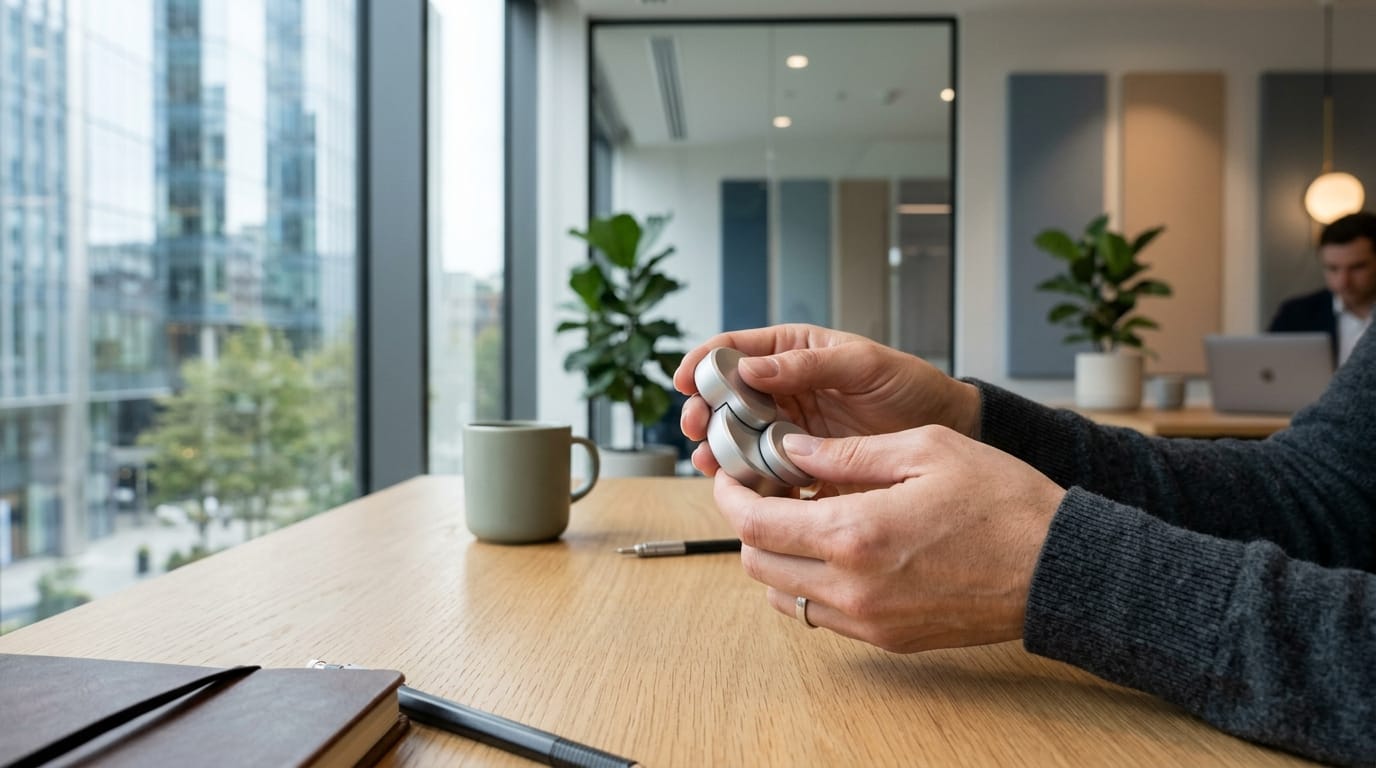
For many, the sight of an adult manipulating a tactile object in a boardroom evokes memories of the 2017 fidget spinner craze—a viral trend that, while highlighting sensory needs, was often dismissed as a classroom distraction. However, as Why Keeping Your Hands Busy Helps Calm Your Mind explores, the clinical reality is far more profound. The ‘Objections’ branch tackles the common doubts and social stigmas adults face when considering sensory tools for everyday focus and relaxation. Despite the lingering ‘childish’ label, the shift toward professional-grade sensory aids is undeniable. By 2025-2026, the market has pivoted toward ‘Morandi’ color palettes, natural wood finishes, and silent magnetic mechanisms—such as the Stimagz Dubz released in April 2025—designed specifically for the discreet demands of the modern workspace. These office-appropriate tools are engineered to operate under 30dB, ensuring that productivity gains do not come at the cost of colleague focus.
The data supporting this integration is compelling. Research indicates that repetitive hand movements are linked to increased brain-derived neurotrophic factor (BDNF) expression, providing a biological basis for cognitive regulation. Experimental trials now report 15-20% improvements in sustained attention after only 10-20 minutes of focused hand activity. This physiological benefit is translating into corporate success, with a 2026 survey revealing that 62% of employees report higher productivity when using subtle tactile stimulation. With the stress toy market projected to grow to $7.95 billion by 2030 at a CAGR of 6.1%, and an anticipated trajectory reaching $22.8 billion by 2033, we are witnessing the transition of these devices from novelty toys to essential, tech-enhanced cognitive aids.
The Science of ‘Idle’ Hands: How Small Movements Regulate the Nervous System
The physiological imperative behind what we colloquially term ‘fidgeting’ is rooted in a sophisticated neurological feedback loop known as the hand-brain-emotion axis. While the 2017 viral phenomenon of the fidget spinner was often dismissed as a classroom distraction, the current 2025-2026 landscape reflects a more nuanced understanding of sensory regulation. Today, professionals are gravitating toward tools that prioritize discretion, such as those with silent magnetic mechanisms—most notably the Stimagz Dubz launched in April 2025—and aesthetics featuring ‘Morandi’ color palettes and natural wood finishes, ensuring office-appropriate operation at under 30dB.
This shift is supported by compelling data: a 2026 survey found that 62% of employees report higher productivity when utilizing these subtle tactile stimuli. Neurologically, this is not merely a diversion. Experimental trials indicate that 10-20 minutes of focused hand activity can yield 15-20% improvements in sustained attention. Furthermore, repetitive hand movements are directly linked to increased brain-derived neurotrophic factor (BDNF) expression, which facilitates neural plasticity and cognitive resilience. As noted in recent research, the repetitive and rhythmic motions involved in fiber art can produce effects akin to mindfulness meditation, stimulating the parasympathetic nervous system and lowering levels of stress hormones.
By engaging the somatosensory cortex through rhythmic, tactile engagement, individuals can effectively down-regulate sympathetic nervous system activation, commonly known as the ‘fight or flight’ response. As the stress toy market is projected to reach $7.95 billion by 2030, and eyes a long-term expansion toward $22.8 billion by 2033, the focus is clearly shifting from simple diversion to high-utility, personalized, and modular tools designed for sustained neuro-regulation in the modern workspace.

Channeling Restless Energy: From Distraction to Anchored Attention
While the 2017 surge of fidget spinners often prompted classroom bans, the landscape for sensory regulation has evolved into a sophisticated discipline of cognitive maintenance. In 2026, the stigma once associated with restless movement has dissolved, replaced by a strategic integration of tactile stimulation into the professional workflow. As noted by industry analysts, studies show that the act of fidgeting can channel nervous energy, substitute for less desirable habits, and offer a calming sensory experience.
This shift is evidenced by the modern office aesthetic, which now prioritizes ‘Morandi’ color palettes and natural wood finishes, moving away from neon plastic toward discreet, silent magnetic mechanisms—such as the Stimagz Dubz launched in April 2025. For the contemporary adult professional, these tools are not toys but ergonomic aids; research indicates that office-appropriate devices operating under 30dB are critical to maintaining concentration without disrupting the work environment. The physiological basis for this trend is compelling, with experimental trials reporting 15-20% improvements in sustained attention after 10-20 minutes of focused hand activity. Furthermore, repetitive hand movements are increasingly linked to the upregulation of brain-derived neurotrophic factor (BDNF), suggesting that these micro-movements support neuroplasticity.
The efficacy of this approach is backed by data, as 62% of employees in a 2026 survey reported higher productivity when using subtle tactile stimulation. As the stress toy market is projected to grow to $7.95 billion by 2030 at a CAGR of 6.1%, the trajectory points toward a $22.8 billion industry by 2033, characterized by personalized and tech-enhanced modular tools. By channeling kinetic energy into controlled sensory anchors, professionals are successfully substituting detrimental habits with regulated, productivity-enhancing neural focus.

Evidence in Action: Real-World Use Cases and Testimonials
The trajectory of tactile sensory tools has evolved significantly since the viral, often disruptive trends of 2017. Today’s professional landscape favors sophisticated, “Morandi”-inspired aesthetics and silent mechanical integration, as evidenced by the April 2025 launch of magnetic fidget solutions like Stimagz Dubz. Clinical observation supports this transition, with experimental trials indicating that 10-20 minutes of focused hand activity can yield 15-20% improvements in sustained attention. These repetitive motions are not merely distracting habits; they are physiologically linked to increased brain-derived neurotrophic factor (BDNF) expression, fostering neural plasticity.
Data from a 2026 workplace survey highlights the practical efficacy of this integration. According to industry research, 62% of employees reported higher productivity when using subtle tactile stimulation, with users noting that anecdotal feedback strongly echoes these quantitative findings. To maintain professional decorum, current best practices mandate that office-appropriate tools operate below 30dB, ensuring that individual sensory regulation does not infringe upon the focus of colleagues.
This shift toward professional-grade sensory support reflects a broader economic trend. The stress toy market, valued at $7.95 billion in 2030 with a 6.1% CAGR, is projected to reach a valuation of $22.8 billion by 2033. As the workplace continues to value personalized, modular, and tech-enhanced tools, the integration of silent, tactile aids appears poised to become a staple of modern cognitive ergonomics.
Choosing the Right Tool: What Makes a Fidget Effective for Focus?
In the landscape of modern professional cognitive support, the evolution of tactile aids has moved beyond the disruptive trends of 2017 to sophisticated, office-ready implements. As 62% of employees surveyed in 2026 report heightened productivity through subtle tactile stimulation, the criteria for selecting an effective tool have become increasingly specialized. Clinical trials demonstrate that 10-20 minutes of focused hand activity can lead to a 15-20% improvement in sustained attention, a phenomenon supported by evidence that repetitive hand movements are linked to increased brain-derived neurotrophic factor (BDNF) expression. To harness these neurological benefits without infringing upon professional environments, users must prioritize three pillars: acoustics, ergonomics, and aesthetics.
The standard for acoustic privacy is strictly defined; as noted in the Titan Fidget 2026 Comprehensive Guide, the optimal tool must achieve “Near-silent operation — No audible sound above ambient office noise (under 30dB).” Adhering to this limit prevents social friction while allowing the user to focus. Ergonomically, tools designed for one-handed use permit continuous engagement during meetings or deep work sessions, facilitating a seamless transition between tasks.
Aesthetic preferences have also matured. The 2025-2026 market shift toward Morandi color palettes and natural wood finishes reflects a desire for tools that integrate naturally into a high-end workspace. Innovation in mechanism design, such as the magnetic systems found in tools like the Stimagz Dubz launched in April 2025, provides high-sensory feedback through silent, haptic resistance. As the global stress toy market tracks toward a projected $7.95 billion by 2030, with further growth to $22.8 billion expected by 2033, the focus remains on modularity and tech-enhanced personalization, ensuring that the next generation of productivity tools is as discrete as it is functional.
Conclusion: Reframing the Utility of Keeping Hands Busy
The evolution of tactile engagement has traversed a significant arc, moving from the disruptive viral nature of 2017 fidget spinners to the sophisticated, office-ready integration we see in 2026. As the sensory toy market expands toward a projected $22.8 billion valuation by 2033, we are witnessing a fundamental shift from ‘toy’ to ‘therapeutic tool.’ This maturation is underscored by a design language favoring Morandi palettes, natural wood, and silent magnetic mechanisms—such as the Stimagz Dubz launched in April 2025—which ensure that tools operate under 30dB, keeping environments professional and focused.
The neurobiological benefits of this shift are profound. Repetitive hand movements are increasingly linked to the upregulation of brain-derived neurotrophic factor (BDNF), while experimental trials confirm that 10–20 minutes of focused tactile activity can yield 15–20% improvements in sustained attention. For the modern workforce, this is no longer mere play; it is a vital strategy for cognitive load management. Indeed, 62% of employees report higher productivity when utilizing these tools, as further explored in our analysis of Why Keeping Your Hands Busy Helps Calm Your Mind.
As noted by industry analysts, the market is currently transitioning from “general sensory play” to products targeting highly specific developmental or therapeutic needs. With the stress toy sector expected to reach $7.95 billion by 2030, our understanding of these instruments must continue to evolve. By integrating discreet, high-utility fidget mechanisms into the workplace, professionals can effectively harness sensory feedback to sharpen focus, reduce stress, and optimize cognitive performance in an increasingly demanding digital era.
Frequently Asked Questions
Research suggests that controlled movement, often called ‘fidgeting,’ helps regulate dopamine and norepinephrine levels in the brain. By engaging tactile pathways, these movements minimize sensory overload, allowing the prefrontal cortex to prioritize information processing. This stabilization creates a unique physiological state that enhances sustained attention during complex, high-stakes tasks.
Low-impact, repetitive motions are most effective for maintaining focus without causing distraction. Occupational therapists recommend using silent tactile tools like textured worry stones, stress balls, or discreet rings. These movements occupy the motor cortex just enough to prevent mind-wandering while allowing the brain to remain alert during intense cognitive work.
While minor movement aids focus, hyperactive fidgeting can sometimes signal sensory processing dysregulation or anxiety. If movements become erratic, loud, or visually disruptive to peers, they may diminish productivity. It is essential to use quiet, controlled physical outlets that support sensory regulation without interfering with precise motor tasks or communication.