
Screen-Free Calming Rituals: How to Stop Doomscrolling
By Kevin Lee | 4/30/2026
The Dopamine Loop: Why Doomscrolling is the Default
In the digital architecture of 2026, the scroll is no longer a conscious choice but a physiological default. As noted by experts, prolonged scrolling of social-media feeds—especially ‘doom-scrolling’ of short-form videos—elicits the opposite pattern, with heightened sympathetic arousal that raises blood pressure, creates muscle tension in the neck and shoulders, provokes headaches and nausea, disrupts sleep, spikes dopamine with each scroll, and sustains elevated cortisol and anxiety-related hormones. This high-arousal state has necessitated a shift in clinical practice, as therapists now move beyond talk therapy to prescribe ‘sensory diets’—physical interventions designed to recalibrate a nervous system trapped in a digital feedback loop.
We are witnessing a profound evolution in how we manage focus. Where fidget spinners once acted as a catalyst for normalizing adult-oriented sensory tools, the landscape has matured into a multi-billion dollar industry; the ADHD productivity tools sector is projected to reach 7.55 billion dollars by 2033. This growth reflects a broader understanding of neurodivergence, particularly as 95.8 percent of children with autism spectrum disorder grapple with sensory processing deficits, a reality that has pushed these solutions into the mainstream. Indeed, 72 percent of therapists now explicitly recommend fidget toys for stress and focus management.
The efficacy of these tools lies in their ability to engage the brain in ways that digital media cannot. Bilateral stimulation through repetitive hand movements, for instance, activates both brain hemispheres to interrupt cyclical anxiety, while weighted sensory tools now boast Grade A clinical backing for sleep and anxiety reduction. Even visual regulation plays a role; simply watching moving sand art can drop skin temperature by roughly 0.75 degrees Celsius, providing a physiological ‘brake’ to the sympathetic nervous system. To understand why our brains are so susceptible to these inputs, see our deep dive on Why Your Brain Craves Tactile Satisfaction and Everyday ASMR. As we look toward the future, the trend is moving toward ‘multimodal’ devices that combine tactile, visual, and auditory feedback—a necessity for a workforce increasingly integrating these sensory tools into professional design to combat the persistent friction of digital overstimulation.
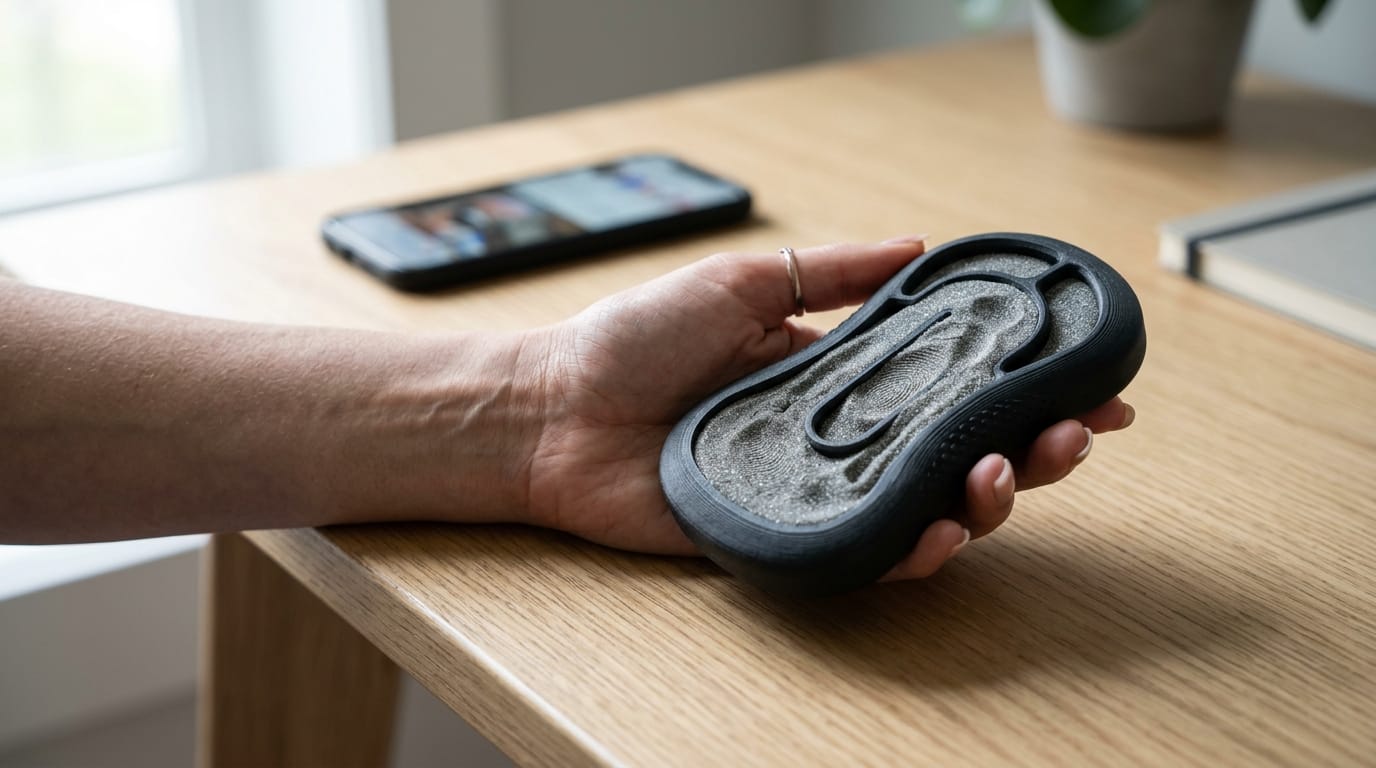
The Tactile Pivot: Sensory Input as a Neural Interrupt
In an era defined by hyper-connectivity, the transition from niche subcultures—where ASMR and early fidget spinners first gained traction—to mainstream clinical application has been rapid. Therapists now formally prescribe ‘sensory diets,’ recognizing that digital overstimulation requires a physiological, not just psychological, counterbalance. As noted in the 2026 Guide to Desk Stress Relief, “Sensory grounding: Touch receptors send signals to your brain that compete with stress signals.” This mechanism serves as a neural interrupt, effectively overriding the sympathetic nervous system’s response to screen-based stimuli.
The efficacy of these interventions is backed by substantial data. Bilateral stimulation through repetitive hand movements is now understood to engage both brain hemispheres, providing a mechanical disruption to anxiety loops. The clinical utility is further supported by the fact that 72 percent of therapists now recommend fidget tools for stress and focus management. For specialized populations, the need is even more acute: with 95.8 percent of children on the autism spectrum exhibiting sensory processing deficits, the broader adoption of these tools is a clinical necessity. Furthermore, the use of weighted sensory apparatuses now carries Grade A clinical backing for their efficacy in sleep and anxiety reduction, while visual feedback—such as the 0.75 degree Celsius skin temperature drop observed when watching moving sand art—demonstrates the multi-sensory potential of the desk environment.
Looking toward the future, the ‘multimodal’ trend is set to merge tactile, visual, and auditory feedback into singular devices, signaling an integration of sensory ergonomics into standard workplace design. This movement is not merely a lifestyle shift; it is a burgeoning economic reality, with the ADHD productivity tools sector projected to reach 7.55 billion dollars by 2033, confirming that tactile grounding is no longer optional—it is essential infrastructure for the modern mind.
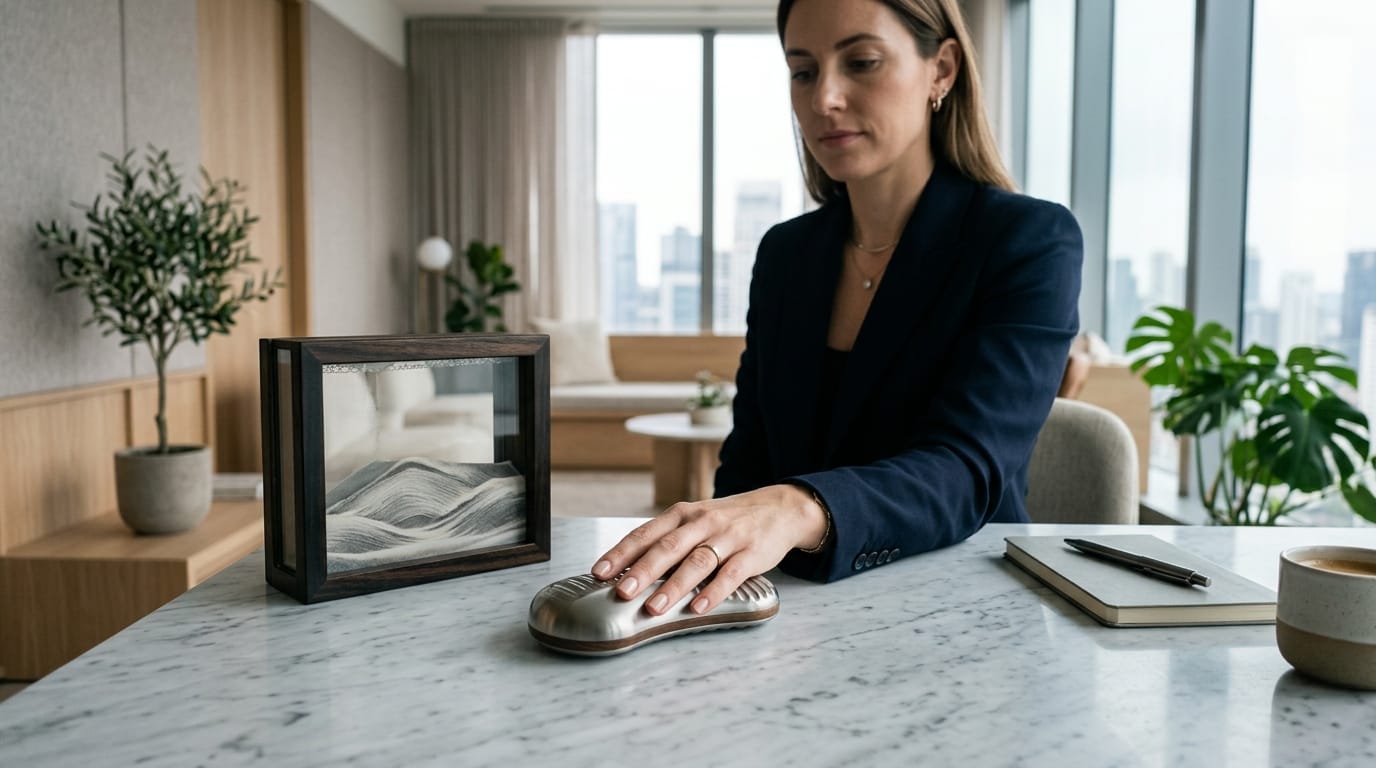
Visual Anchors: Moving-Sand Art and the Science of Slow Motion
In an era defined by high-frequency digital interactions, the medical community is observing a significant shift in therapeutic modalities. As the ADHD productivity tools sector is projected to reach 7.55 billion dollars by 2033, we are seeing a move away from purely software-based solutions toward ‘sensory diets’ that integrate tactile and visual grounding. Following the mainstreaming of fidget spinners and the migration of ASMR from niche subculture to clinical application, moving-sand art has emerged as a sophisticated, low-tech biofeedback tool.
The efficacy of these visual anchors lies in their ability to engage the brain’s autonomic regulation. Research indicates that 72 percent of therapists now recommend fidget toys for stress and focus management, particularly as 95.8 percent of children with autism spectrum disorder grapple with sensory processing deficits, a reality that underscores the broader utility of these tools for neurodivergent adults as well. When a user interacts with sand art, the bilateral stimulation—facilitated by repetitive hand adjustments—serves to interrupt anxiety loops by engaging both brain hemispheres simultaneously.
The physiological impact is quantifiable. As noted in recent studies, “Watching moving sand art produces an immediate calming physiological profile: heart-rate variability rises, skin temperature drops by roughly three-quarters of a degree Celsius, overall heart rate shows brief bursts of excitement yet settles into a regulated autonomic state dominated by parasympathetic activity” (Museums Association Research). This 0.75-degree Celsius reduction in skin temperature serves as a tangible indicator of reduced sympathetic nervous system arousal.
Looking ahead, we anticipate a rise in ‘multimodal’ tools that synthesize these visual anchors with weighted sensory features, which already carry Grade A clinical backing for sleep and anxiety reduction. As these tools are integrated into professional workplace design, they transition from mere novelties to essential components of a healthy cognitive architecture, balancing our high-speed digital lives with the necessary discipline of slow-motion observation.
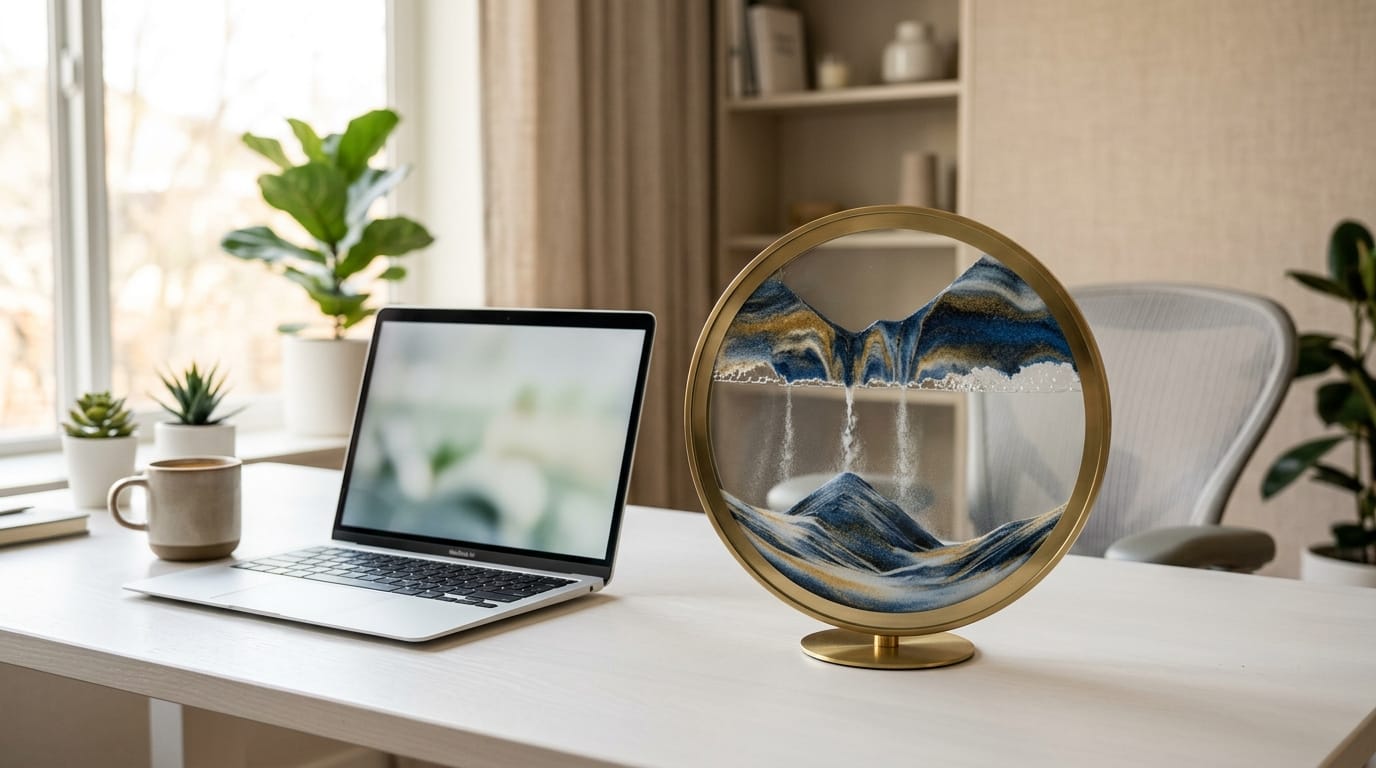
Building Your Bedside Sensory Toolkit
In an era where the ADHD productivity tools sector is projected to reach 7.55 billion dollars by 2033, the integration of tactile and visual aids into our private living spaces has evolved from a niche subculture to a foundational element of clinical wellness. As 72 percent of therapists now recommend fidget toys for stress and focus management, practitioners are increasingly prescribing ‘sensory diets’ to mitigate the effects of digital overstimulation. To curate an effective bedside toolkit, one must categorize tools by their physiological impact on the nervous system.
For visual and thermal regulation, One Quiet Mind highlights that “visual-tactile hybrids like miniature zen gardens, moving-sand art frames and textured light projectors provide soothing motion and texture.” Notably, watching moving sand art can drop skin temperature by roughly 0.75 degrees Celsius, providing a physiological signal of cooling calm. For tactile intervention, bilateral stimulation tools—ranging from textured stress balls to smooth worry stones—are essential; repetitive hand movements activate both brain hemispheres to effectively interrupt acute anxiety loops.
Finally, we must consider the role of proprioception in restorative rest. Weighted sensory tools now possess Grade A clinical backing for sleep and anxiety reduction, serving as a critical bridge between the normalizing influence of past fidget-based trends and the multimodal future of sensory design. While 95.8 percent of children with autism spectrum disorder have documented sensory processing deficits, the broader adult population is now finding that these tools offer a vital stabilization mechanism for the modern, high-stimulation lifestyle.
Routine Design: The 15-Minute Screen-Free Transition
As we navigate a future where the ADHD productivity tools sector is projected to reach 7.55 billion dollars by 2033, the clinical transition from digital overstimulation to restorative sleep requires a structured sensory protocol. While ASMR and fidget tools have migrated from niche internet subcultures to mainstream clinical wellness, therapists are now formalizing this shift by prescribing ‘sensory diets’—a necessity underscored by the fact that 95.8 percent of children with autism spectrum disorder grapple with sensory processing deficits, a reality that informs our broader understanding of adult neurodivergence. According to a practical guide from Gentle Resilience Studio, the evening ritual begins 60 minutes before bedtime with a concrete phone-down trigger: place the device face-down on a nightstand outside the bedroom or enable a scheduled Do-Not-Disturb and swap it for a tactile anchor.
The 15-minute transition protocol leverages several physiological levers. First, engage with a weighted sensory tool; these devices now hold Grade A clinical backing for sleep and anxiety reduction, effectively grounding the nervous system. Second, utilize visual focus tools—such as moving sand art—which research indicates can drop skin temperature by roughly 0.75 degrees Celsius, signaling the body to enter a sleep-ready state. Finally, incorporate bilateral stimulation through repetitive hand movements. As 72 percent of therapists now recommend, these tactile inputs activate both brain hemispheres to interrupt the cyclic loops of digital anxiety. This transition reflects the emerging ‘multimodal’ trend, where tools combine tactile and visual feedback to replace the dopamine-heavy experience of doom-scrolling with a neurobiologically soothing alternative.
Conclusion: Reclaiming Rest through Intentional Touch
The evolution of sensory regulation marks a definitive shift from passive digital consumption to the active, intentional engagement of our tactile senses. As we navigate a landscape where 72 percent of therapists now integrate fidget toys into standard clinical protocols for focus management, it is clear that sensory tools have migrated from niche internet subcultures to essential wellness requirements. This transition is not merely trend-based; it is physiological. Whether observing the cooling effect of moving sand art—which can lower skin temperature by approximately 0.75 degrees Celsius—or utilizing bilateral stimulation to bridge brain hemispheres and interrupt anxiety cycles, the evidence is robust. With the ADHD productivity tools sector projected to reach 7.55 billion dollars by 2033, the market is finally acknowledging the 95.8 percent of children with autism spectrum disorder who experience sensory processing deficits and require targeted intervention.
As noted by experts in the field, “These are especially effective for children and adults who struggle with transitions (bedtime, leaving the house, ending work) and need multi-sensory cues to shift states.” Clinical findings on sensory regulation confirm that while weighted tools provide Grade A support for sleep, the future lies in the integration of “multimodal” devices that harmonize tactile, visual, and auditory feedback into professional workspace design. To understand the deeper neurological underpinnings of this shift, one must consider Why Your Brain Craves Tactile Satisfaction and Everyday ASMR as a fundamental component of neurodiversity and stress management. By reclaiming our capacity for intentional touch, we provide our nervous systems the grounding necessary to resist the constant pull of digital overstimulation. — Kevin Lee.
Frequently Asked Questions
Constant exposure to negative news cycles triggers chronic stress responses, flooding your brain with cortisol. By 2026, research confirms this cycle disrupts deep sleep patterns and cognitive focus. Replacing screen time with physical calming rituals helps regulate your nervous system, promoting mental clarity and reducing the risk of anxiety-related burnout.
Engaging in tactile activities like journaling, gentle stretching, or reading physical books signals your brain to transition into rest mode. These screen-free habits prevent the blue light exposure that suppresses melatonin production. Prioritizing these rituals helps restore your natural circadian rhythm, ensuring better sleep hygiene and improved emotional resilience daily.
Establish firm tech-free zones, such as the bedroom or dinner table, to reclaim your personal space. Utilize grayscale display settings to make interfaces less stimulating, effectively reducing the dopamine feedback loop. Consistent boundaries are vital for maintaining mental health, helping you disconnect from digital noise and reconnect with your environment.
Expert Resources