
Interrupting Stress: The Power of Tactile Grounding
By Kevin Lee | 5/1/2026
The Cognitive Feedback Loop: Why Stress Feels Impossible to Stop
In the modern clinical landscape, stress is no longer viewed merely as a reaction to external stimuli, but as a self-reinforcing cognitive feedback loop that traps the prefrontal cortex in a cycle of rumination. Once a niche interest, the use of ASMR and sensory-tactile tools has evolved into a cornerstone of 2026 mental health practice, with 72% of therapists now endorsing fidget devices to anchor patients in the present. This shift acknowledges that when the brain perceives danger, it requires a somatic ‘interrupt’ to break the cycle. As noted in One Quiet Mind research, sensory toys function by bringing us back to the present moment, allowing the individual to determine the reality of their surroundings and choose a constructive path forward. Understanding the neurobiology behind this is critical, as Why Your Brain Craves Tactile Satisfaction and Everyday ASMR highlights, current data confirms that tactile stimulation—specifically stroking at 3 cm/s—triggers a rapid release of oxytocin in the prelimbic prefrontal cortex.
This physiological regulation is measurable; clinical trials indicate that tactile grounding tools can improve heart-rate variability (SDNN) by a median of 0.034–0.036 s, providing a tangible metric for anxiety reduction. The therapeutic strategy now varies by sensory input: smooth textures are utilized to lower arousal, while rough surfaces are employed to sharpen awareness and redirect intrusive thoughts. With the ADHD productivity tools sector projected to reach $7.55 billion by 2033, the focus is shifting toward the future of multimodal integration, where tactile tools will be seamlessly paired with scent or auditory feedback to act as standard circuit breakers for high-stress states. By Kevin Lee.
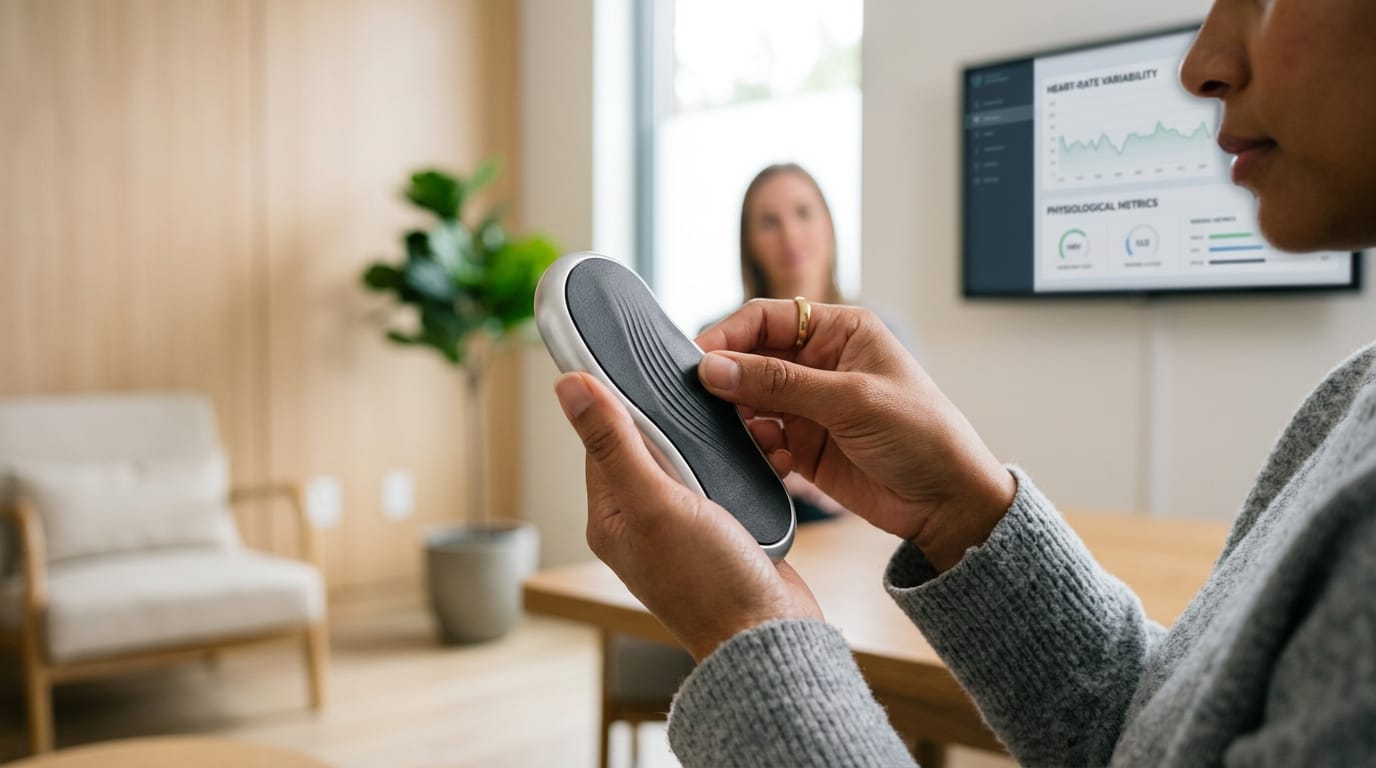
Neurological Circuit Breakers: How Tactile Grounding Actually Works
Once dismissed as mere childhood habits or fringe digital subcultures, tactile grounding has ascended to a pillar of modern therapeutic practice. In 2026, clinical consensus solidified behind the practice, with 72% of therapists now routinely recommending fidget tools to manage stress and cognitive load—a shift that mirrors the burgeoning ADHD productivity sector, now projected to reach $7.55 billion by 2033. At the center of this transformation is the ‘competing signals’ theory, which posits that targeted tactile input acts as a neurological circuit breaker, overriding the amygdala’s hyper-arousal with calibrated sensory data.
The mechanism behind this regulation is increasingly understood at a molecular level. Recent research published in the Journal of Neuro-Molecular Dynamics clarifies that “social-touch-like stroking (approximately 3 cm s-1) triggers rapid oxytocin release in the prelimbic prefrontal cortex, where the peptide enhances glutamatergic coherence and suppresses stress-induced hyper-excitability.” By stimulating these specific pathways, patients can effectively dampen sympathetic nervous system responses, with clinical data showing that tactile grounding tools can improve heart-rate variability (SDNN) by a median of 0.034–0.036 seconds.
The efficacy of these interventions remains highly texture-dependent, serving as a versatile tool for emotional regulation. Smooth, repetitive textures are clinically proven to lower autonomic arousal, whereas rougher surfaces—such as those modeled after sandpaper—sharpen sensory awareness, providing the friction necessary to redirect intrusive thoughts. As we look toward future iterations of these tools, the industry is already pivoting toward multimodal sensory integration, moving beyond single-mode tactile devices toward systems that synchronize tactile feedback with scent or auditory cues to create a more robust interruption of the stress response.

Texture as Signal: Why Your Brain Prioritizes Touch Over Worry
Historically dismissed as mere niche internet trends or juvenile behaviors, tactile-based grounding has evolved into a cornerstone of contemporary clinical practice. By 2026, the data confirms its efficacy: 72% of mental health professionals now incorporate fidget tools into their treatment protocols to manage stress and cognitive load. The neurobiology underpinning this shift is striking. Research confirms that social-touch-like stroking—applied at a rate of 3 cm/s—triggers an immediate release of oxytocin within the prelimbic prefrontal cortex, effectively dampening the neurological signatures of anxiety. This physiological intervention is not merely subjective; it is measurable, with tactile grounding tools shown to increase heart-rate variability (SDNN) by a median of 0.034–0.036 seconds, indicating a measurable shift toward parasympathetic dominance.
The therapeutic utility of these tools lies in the specific signals they send to the brain. As noted by Ahead, “Smooth objects like polished stones or glass beads often calm your mind through their cooling, soothing properties. Rough textures like sandpaper or bark engage more intense focus, redirecting attention from intrusive thoughts.” By selecting textures tailored to their immediate needs, patients can oscillate between states of deep regulation and heightened alertness. This targeted neuro-modulation is fueling a massive shift in the wellness market, with the ADHD productivity tools sector now projected to reach a valuation of $7.55 billion by 2033. As we look ahead, the medical community is moving toward integrating these tactile inputs with multimodal sensory stimuli, such as scent or auditory cues, to create even more robust frameworks for high-stress interruption.

The 60-Second Reset: Practical Workday Grounding Techniques
Once dismissed as niche internet culture or mere childhood restlessness, tactile grounding has ascended to a mainstream clinical intervention for the modern professional. As of 2026, 72% of therapists actively recommend sensory tools to manage workplace stress and sharpen cognitive focus, a shift underscored by a burgeoning ADHD productivity sector now projected to reach $7.55 billion by 2033. This professional adoption is supported by empirical findings: mechanical stroking at a rate of 3 cm/s has been shown to trigger rapid oxytocin release in the prelimbic prefrontal cortex, a mechanism that effectively recalibrates the autonomic nervous system. Clinically, consistent use of these devices has been observed to increase heart-rate variability (SDNN) by a median of 0.034–0.036 s, providing a tangible metric for physiological recovery during high-pressure intervals.
High-efficiency reset devices, such as magnetic sliders and tactile rollers, serve as the frontline for these interventions. Sophisticated haptic tools are designed to manipulate arousal states; smooth, frictionless textures are engineered to lower physiological arousal, whereas rougher textures like specialized coatings serve to sharpen awareness and redirect intrusive, task-interfering thoughts. As noted by industry experts, “ONO offers up another option: two frictionless Rollers that you can smoothly and silently turn in your hand.” This quiet, repetitive motion facilitates a rapid neurological transition, moving the user from a state of reactive stress to one of executive clarity. Looking ahead, the clinical standard is shifting toward multimodal integration, with upcoming protocols layering tactile stimulation with calibrated scent or auditory inputs to create more robust interruptions to the stress-response cycle.
Beyond the Fidget: Integrating Grounding into a Professional Routine
Once dismissed as niche internet subculture or childhood distraction, tactile grounding has ascended to a cornerstone of modern clinical practice. By 2026, 72% of therapists actively recommend these tools, a shift validated by neuroscience; we now know that social-touch-like stroking at a rate of 3 cm/s triggers a rapid release of oxytocin in the prelimbic prefrontal cortex, effectively modulating stress responses in real-time. As explored in our analysis of Why Your Brain Craves Tactile Satisfaction and Everyday ASMR, these neurological pathways are key to maintaining professional equilibrium.
For the modern executive, the transition from ‘distraction’ to ‘essential gear’ is best exemplified by the humble fidget pen. As noted by WPsych Service, “The Fidget Pen easily blends into almost any setting, offering a ‘hidden in plain sight’ experience. It acts like Superman in disguise.” This rebranding reflects a broader trend, with the ADHD productivity tools sector projected to reach $7.55 billion by 2033. Clinically, these devices are powerhouses; data indicates that tactile grounding tools can improve heart-rate variability (SDNN) by a median of 0.034–0.036 s, providing measurable physiological stability during high-stakes boardroom negotiations.
The efficacy of these tools lies in sensory modulation: smooth textures serve to lower physiological arousal, while rougher surfaces—such as those mimicking sandpaper—can sharpen awareness to successfully redirect intrusive thoughts. As we look toward the future, we anticipate the standardization of multimodal interventions, such as devices pairing tactile input with scent or auditory cues. In the current landscape, however, incorporating a discreet, tactile-grounding implement into your daily carry is no longer a concession to restlessness; it is a scientifically backed strategy for sustained peak performance.
Frequently Asked Questions
Tactile grounding redirects your brain’s focus from internal emotional turmoil to immediate physical sensations. By engaging your sense of touch, such as holding a textured object, you trigger the parasympathetic nervous system. This biological response slows your heart rate, lowers cortisol, and interrupts the cycle of escalating physiological stress responses effectively.
While tactile grounding is an excellent immediate tool for managing acute stress spikes, it is intended as a supplemental strategy rather than a comprehensive replacement for clinical therapy. If you experience chronic anxiety that disrupts your daily functioning, we recommend consulting a medical professional to build a robust, evidence-based treatment plan.
The most effective grounding objects offer distinct textures or temperatures. Common items include smooth river stones, textured stress balls, velvet fabrics, or even ice cubes. The goal is to choose an item that creates a clear, undeniable sensory contrast, allowing your nervous system to pivot away from intrusive thoughts and regain stability.