
How to Stop Picking Your Nails at Your Desk
By Kevin Lee | 4/25/2026
Introduction: The Desk Habit Trap
In the high-pressure environment of the modern office, the rhythmic cadence of keyboard typing is often punctuated by a less professional, yet deeply habitual sound: the nervous clip of a nail-biter. While often stigmatized as a lapse in willpower, research suggests that nail-biting is less about behavioral failure and more about a persistent sensory need. According to Hands Off App, nail biting affects nearly 30% of children and up to 45% of teenagers, with many adults continuing the habit well into adulthood. This compulsion to bridge the gap between mental stagnation and focus-driven activity is a physiological response, and understanding Why Keeping Your Hands Busy Helps Calm Your Mind is the first step toward effective regulation.
The marketplace has shifted dramatically to address this, evolving far beyond the rudimentary fidget spinners of 2017. Today, the global sensory toys market is valued at 2.46 billion USD in 2026, with projections indicating growth to 6.16 billion USD by 2035. As North America leads this sector with a 53% market share, product sophistication has accelerated; notably, 39% of sensory toys launched in 2024 began integrating digital elements such as light, sound, or vibration. This trend toward high-tech regulation is exemplified by the April 2025 launch of the Stimagz Dubz magnetic fidget mechanism, which caters specifically to the adult professional. Even traditional tools are subject to rigorous scrutiny, as evidenced by the February 2026 revision of durability rankings, where the Fidget Pen achieved a score of 36. As corporate wellness programs increasingly integrate these tools through 2030, we must move past the idea that desk fidgeting is a distraction, and instead view it as a calibrated method for managing cognitive load.
Why We Pick: The Psychology of Nervous Habits
Onychophagia, more commonly known as chronic nail-biting, remains one of the most pervasive body-focused repetitive behaviors (BFRBs). Clinical data indicates that this habit affects nearly 30% of children and up to 45% of teenagers, often persisting into the professional environment. As noted in research published in Acta Dermatovenerol APA, ‘Onychophagia is closely related to stress. One hypothesis suggests that nail-biting acts as a mechanism to relieve stress.’ In the high-pressure landscape of 2026, where the Global Sensory Toys Market has reached a valuation of 2.46 billion USD, professionals are increasingly turning to tactical alternatives to manage the workplace triggers of stress and concentration fatigue.
The evolution from the fidget spinner craze of 2017 to sophisticated, adult-oriented tools underscores a shift in corporate coping strategies. North America currently leads this sensory toy market with a 53% share, driving innovation as seen with the April 2025 launch of the Stimagz Dubz magnetic fidget mechanism. Furthermore, quality and durability remain paramount for the workforce, exemplified by the Fidget Pen, which scored a 36 in hands-on testing revised as of February 2026. With 39% of sensory toys launched in 2024 integrating advanced digital elements like light, sound, or vibration, the trajectory of this sector is clear; the market is projected to reach 6.16 billion USD by 2035, paralleled by the increasing adoption of stress toys within corporate wellness programs through 2030.

The Sensory Swap: How Tactile Tools Interrupt the Cycle
For the nearly 30% of children and up to 45% of teenagers grappling with nail biting—a behavior often rooted in self-soothing—the transition from harmful fixation to constructive regulation is critical. As the global sensory toys market continues its rapid expansion, valued at 2.46 billion USD in 2026 with projections reaching 6.16 billion USD by 2035, we are witnessing a pivot toward intentional tactile intervention. This movement serves as a deliberate sensory swap, replacing destructive impulses with controlled mechanics. As noted by experts, “Repetitive, small movements—like clicking, twisting, or spinning—can help regulate the nervous system, reduce anxiety, and improve concentration.”
This shift in methodology is increasingly sophisticated. While the 2017 fidget spinner craze served as a foundational awareness tool, the modern market has evolved significantly. By 2024, 39% of new product launches integrated digital elements like light, sound, or vibration to provide enhanced feedback loops. In the current 2026 landscape, durability and refined mechanics take center stage; the Fidget Pen, for instance, recently earned a score of 36 in updated February 2026 testing, and the April 2025 launch of Stimagz Dubz offers a specialized magnetic mechanism tailored specifically for the adult user demographic. North America continues to lead this charge, commanding a 53% share of the market as these tools increasingly permeate corporate wellness programs through 2030, offering a scalable solution to physiological stress regulation.
Choosing Your Tool: Quiet, Discreet, and Satisfying Options
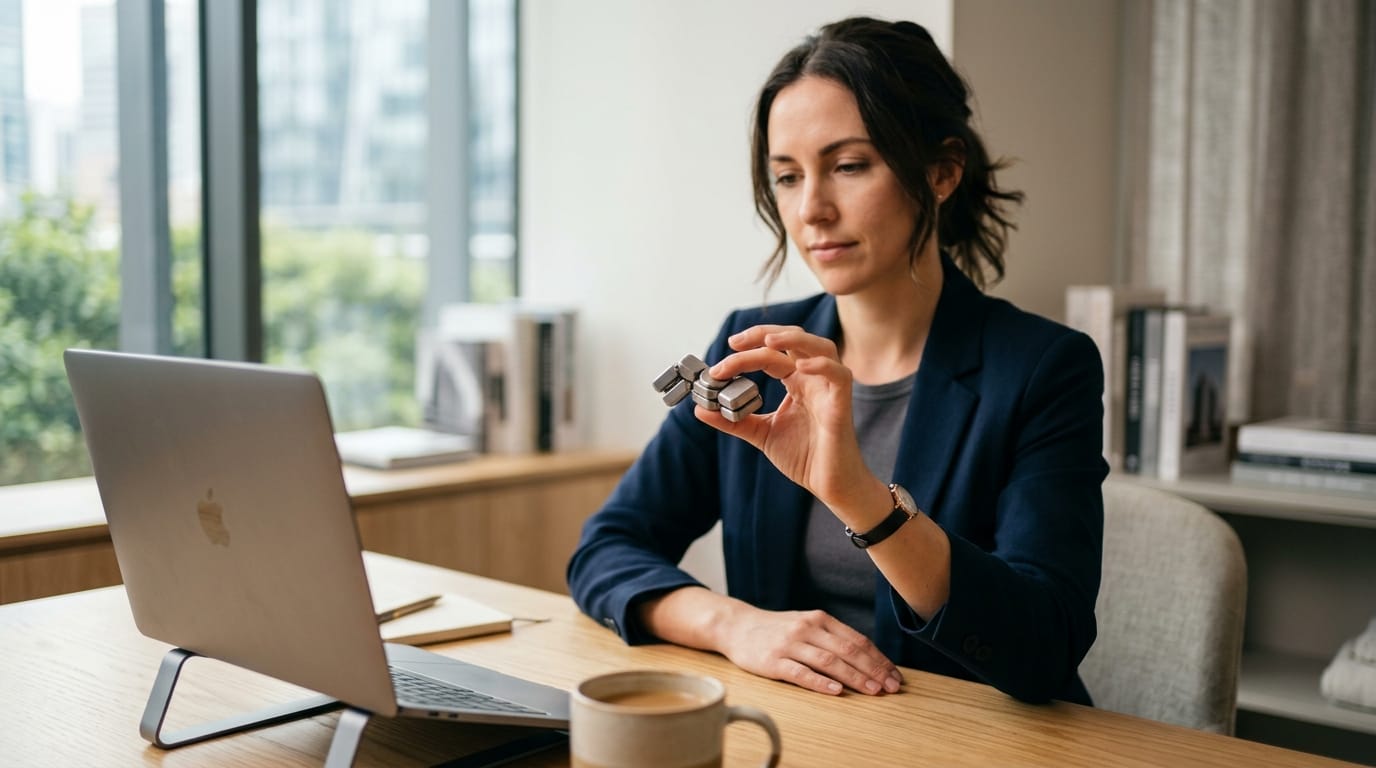
For the modern professional, the evolution of sensory tools has moved far beyond the disruptive fidget spinners of 2017. As the global sensory toys market continues its rapid expansion—valued at 2.46 billion USD in 2026 and projected to hit 6.16 billion USD by 2035—the demand for office-appropriate regulation aids has skyrocketed. With nail-biting affecting up to 45% of teenagers and persisting into adulthood, finding a non-disruptive, tactile outlet is essential for workplace focus. When selecting a tool, discretion and acoustic profile remain paramount.
Among the top performers for corporate environments is the Fidget Pen. As noted in recent industry testing, the pen excels in professional settings, offering a “hidden in plain sight” experience that allows for seamless integration into meetings; it earned a score of 36 during our February 2026 durability and functionality assessments. For those seeking mechanical feedback, the Stimagz Dubz magnetic fidget mechanism, launched in April 2025, offers a sophisticated alternative to traditional clicking devices. These options reflect a broader market shift, where 39% of sensory products now integrate advanced digital elements or refined ergonomics to cater to adults. As corporate wellness programs increasingly adopt these tools through 2030, North America—which currently maintains a 53% share of the sensory market—continues to set the standard for blending physiological regulation with professional aesthetic requirements.
Making the Swap Stick: Practical Steps for Your Desk Routine
Integrating sensory tools into a professional environment requires more than just placement on a desk; it demands a structured approach to behavioral adjustment. As we track the sensory toys market—now valued at 2.46 billion USD in 2026 and projected to reach 6.16 billion USD by 2035—it is clear that tools like the Stimagz Dubz, launched in April 2025, are becoming integral to corporate wellness. To successfully transition from repetitive habits like nail biting, which impacts up to 45% of teenagers and remains prevalent in adults, clinicians recommend Habit Reversal Training (HRT). As defined by the Cleveland Clinic, “Habit reversal training (HRT) is a therapy that helps you stop or reduce the frequency of an unwanted behavior by replacing it with another.”
To implement this protocol at your workstation, first identify your ‘urge’—the specific sensory trigger that precedes the unwanted behavior. Once recognized, immediately pivot to a competing response using your chosen sensory tool. Whether you opt for the Fidget Pen, which achieved a durability score of 36 in our February 2026 revisions, or a modern device utilizing the digital light and vibration feedback found in 39% of 2024’s new product launches, the key is consistency. By anchoring the physical movement of your tool to the moment an urge arises, you rewire the neural pathway of the habit. As North America maintains its lead in this sector with a 53% market share, adopting these evidence-based techniques will likely become a standard component of professional self-regulation through 2030.
Beyond the Desk: Generalizing the Habit Replacement
While professional environments have been the initial focus of sensory integration, achieving long-term success in mitigating body-focused repetitive behaviors (BFRBs) requires normalizing the use of therapeutic tools across all high-stress and idle contexts. As of 2026, the global sensory toys market is valued at 2.46 billion USD and is projected to reach 6.16 billion USD by 2035, reflecting a societal shift toward normalized tactile regulation. This trend is particularly relevant when addressing habits like nail biting, which affects nearly 30% of children and up to 45% of teenagers. As noted by Hands Off, “To stop nail biting, you must identify your triggers, replace the habit with healthier alternatives, use physical deterrents like bitter nail polish or nail biting gloves, and consider behavioral techniques such as habit reversal training.”
The efficacy of these alternatives depends on accessibility and device sophistication. Since the 2017 rise of fidget spinners, innovation has accelerated; notably, 39% of sensory toys launched in 2024 integrated digital elements like light, sound, or vibration to deepen focus. By April 2025, tools such as the Stimagz Dubz magnetic fidget mechanism were specifically optimized for adult users, bridging the gap between clinical utility and lifestyle integration. When selecting your tool, consider that the Fidget Pen scored a 36 in our hands-on testing updated in February 2026, demonstrating that material durability is as critical as design.
With North America leading the sensory toy market with a 53% share, we expect an increasing adoption of these tools in corporate wellness programs through 2030. Integrating these devices into your commute, home life, or travel routine is essential to sustaining progress. To understand the underlying neurology of these interventions, read our recent analysis on Why Keeping Your Hands Busy Helps Calm Your Mind. By transitioning these habits away from the desk and into your daily routine, you move beyond mere distraction and toward meaningful behavioral modification.