
Is it Unprofessional to Fidget in Meetings?
By Kevin Lee | 4/29/2026
Introduction: The Unspoken Fear in the Conference Room
In the modern corporate landscape, a subtle tension persists beneath the veneer of productivity. As a young professional navigating the early stages of a career, the desire to implement cognitive aids often clashes with the rigid expectations of office decorum. This struggle is poignantly captured by one individual who noted: “I’m a young woman in my first post-college position, working for a public institution known for being quirky… I recently acquired a fidget toy to help me focus during long meetings, but I’m worried it looks unprofessional” (Ask A Manager, 2021). This anxiety is not unfounded; we have moved past the era of the low-cost, distracting fidget spinner, which faced significant backlash for its visibility and disruptive noise. Today, the discourse has shifted toward sophisticated wellness, as explained in our recent report on Why Keeping Your Hands Busy Helps Calm Your Mind.
The market is evolving to meet this nuanced demand. While the global sensory toys market is projected to reach USD 6.16 billion by 2035 with an 11% CAGR, the nature of these tools is changing. High-end manufacturers like Baleauty are pivoting to the corporate wellness market with executive-grade tools priced between $35 and $75, offering modular, magnetic, and silent designs that prioritize stealth over spectacle. With North America currently commanding a 53% share of the global market as of 2026, and 39% of new 2024 launches incorporating digital elements like haptic feedback, these devices are becoming as clinical as they are comforting. However, expansion is not without hurdles; 42% of manufacturers cite stringent material safety and compliance standards as a persistent barrier to distribution. Looking ahead, as adoption in corporate wellness programs intensifies, the stress toy market is projected to grow to $7.95 billion by 2030, suggesting that the ‘unspoken fear’ of the conference room may soon be replaced by a standardized, professional acceptance of self-regulation tools.

The Science of Fidgeting and Focus: Not a Distraction, but an Anchor
While the initial popularity of fidget spinners in the previous decade often invited institutional backlash due to their auditory and visual disruptions, the narrative surrounding self-regulation has shifted significantly. We have moved past the era of classroom distractions into a sophisticated era of corporate wellness, where fidgeting is now recognized as a strategic cognitive anchor. According to recent clinical observations, “Repetitive, small movements—like clicking, twisting, or spinning—can help regulate the nervous system, reduce anxiety, and improve concentration,” as noted in a comprehensive industry analysis on the evolution of sensory tools.
This transition is evident in the professional sphere, where high-end manufacturers like Baleauty now offer executive-grade tools priced between $35 and $75, designed specifically to be modular, magnetic, and silent. This market is thriving, with North America currently maintaining a 53% share of the sensory toy sector as of 2026. The integration of technology is also accelerating; notably, 39% of new sensory products released in 2024 incorporated digital elements such as light, sound, or vibration to deepen the sensory experience. These innovations suggest a robust trajectory for the industry, with the broader stress toy market projected to reach $7.95 billion by 2030, and the specialized global sensory market expected to climb to $6.16 billion by 2035 at an 11% CAGR. Despite this growth, manufacturers continue to navigate complex operational hurdles, with 42% citing material safety and regulatory compliance as significant barriers to global distribution.
The Corporate Culture Shift: From Stigma to Wellness Strategy
The perception of sensory regulation tools has undergone a profound metamorphosis. Once dismissed as mere classroom distractions—epitomized by the early, high-visibility fidget spinner craze—these devices have matured into essential components of the modern corporate wellness architecture. This shift is underscored by a robust market trajectory; the Global Sensory Toys Market is expected to reach USD 6.16 billion by 2035 with an 11% CAGR, with North America currently dominating the landscape, accounting for a 53% share as of 2026. As corporate environments increasingly prioritize neurological comfort to boost sustained productivity, premium manufacturers have responded by pivoting toward modular, magnetic, and silent designs tailored for executive suites rather than playgrounds.
This professional evolution is best exemplified by the recent trajectory of specialized providers. Notably, Baleauty launched a dedicated corporate wellness product line featuring executive-grade metal and wood fidget tools in premium packaging, which was adopted by three Fortune 500 companies in its first quarter. These units, priced between $35 and $75, represent a departure from plastic mass-market alternatives, reflecting the integration of higher safety standards. However, scaling remains complex; 42% of manufacturers report material safety and compliance challenges as a barrier to distribution. Furthermore, the landscape is becoming increasingly sophisticated, as 39% of newly launched sensory toys in 2024 integrated digital elements such as light, sound, or vibration to facilitate focus.
Looking ahead, the commitment to cognitive ergonomics shows no signs of waning. With the stress toy market projected to grow to $7.95 billion by 2030, sensory regulation is firmly cementing its role within institutional mental health initiatives. By destigmatizing the use of tactile aids, forward-thinking organizations are transforming individual wellness needs into a cohesive, high-performance cultural asset.

Discreet Design: The Rise of Professional Sensory Tools
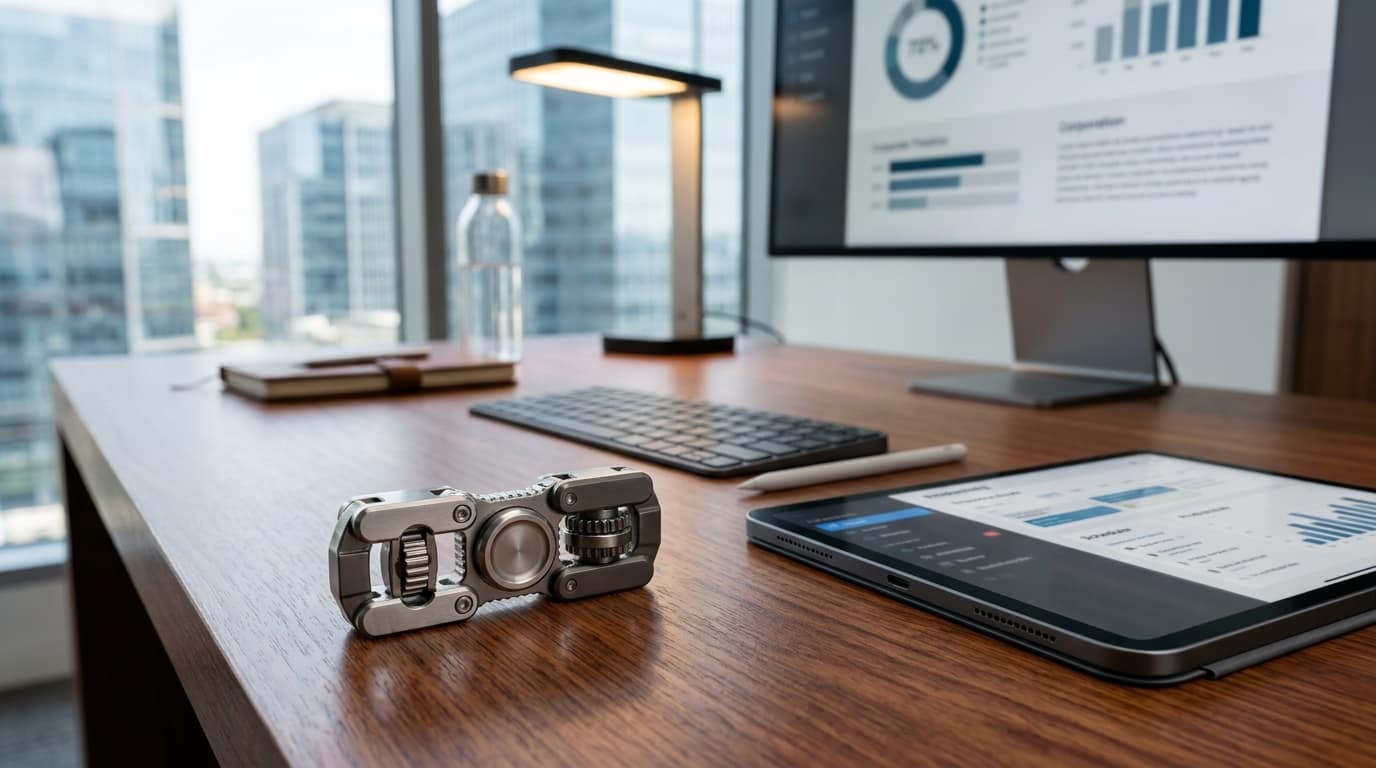
The evolution of sensory regulation tools has undergone a significant paradigm shift since the days when clunky, high-visibility fidget spinners were met with widespread office and school skepticism. As the Global Sensory Toys Market barrels toward a projected USD 6.16 billion valuation by 2035 with an 11% CAGR, the industry is pivoting toward the corporate wellness sector. North America continues to lead this expansion, accounting for 53% of the market share as of 2026. Modern manufacturers are replacing neon plastics with sophisticated, minimalist designs, signaling a transition from mere distraction to professional-grade equipment.
Reflecting this shift, brands like Baleauty have introduced executive-grade fidget tools—priced between $35 and $75—that prioritize silent mechanisms and modular, magnetic components. According to industry research found at Startinal Toy Trends, “The trend is towards toys that use sophisticated, muted color palettes (like the popular Morandi colors), natural wood finishes, and minimalist designs.” These aesthetic choices allow sensory support to integrate seamlessly into high-stakes boardrooms rather than serving as a visual disruption. While 39% of 2024 sensory toy launches integrated digital elements like light or vibration, the luxury segment is finding success by focusing on tactile, analog elegance that bypasses the screen-fatigue common in modern offices.
However, this transition to high-end manufacturing is not without friction. Approximately 42% of manufacturers cite material safety and regulatory compliance as significant hurdles to global distribution. Despite these challenges, the trajectory is clear; with the broader stress toy market projected to reach $7.95 billion by 2030, sensory regulation is firmly cementing its place as a staple of the professional wellness toolkit, blending discreet utility with corporate-appropriate form.
Navigating Social Perception: Practical Tips for the Modern Professional
Integrating sensory regulation tools into a high-stakes corporate environment requires a shift in nomenclature and etiquette. Unlike the disruptive, audible fidget spinners of the past, the modern market—now poised to reach a valuation of USD 6.16 billion by 2035 at an 11% CAGR—prioritizes discreet, silent performance. As North America maintains its lead with a 53% market share, professionals are increasingly adopting executive-grade tools, such as those from Baleauty priced between $35 and $75, which emphasize modular and magnetic mechanics over kinetic distraction. To introduce these tools effectively, one must pivot away from the stigma of recreational play. According to The Metiss Group, it is essential to ‘Position fidget tools as focus aids grounded in brain science, not toys. This framing matters for credibility, especially in executive settings.’ By positioning these devices as cognitive aids, the professional discourse shifts from distraction to self-regulation.
As manufacturers innovate, with 39% of 2024’s sensory product launches integrating subtle digital feedback such as vibration, implementation should focus on minimizing ambient noise and visual interference. While 42% of manufacturers cite material safety and compliance as ongoing production hurdles, the quality of current wellness-focused tools ensures they are built for the longevity of a professional setting. With the stress toy market projected to grow to $7.95 billion by 2030 due to expanding corporate wellness adoption, normalizing these devices is an exercise in workplace culture refinement. Start by using these tools during independent deep-work sessions before moving to team-based settings, ensuring the selected device aligns with your environment’s specific sensory climate.
Conclusion: Redefining Professionalism in the Age of Focus
The evolution of the workplace is no longer defined by the stillness of the past, but by the cognitive efficacy of the present. As we transition from the era where fidget spinners faced institutional backlash to a landscape where North America commands 53% of the global sensory toy market, our definition of workplace decorum must evolve. High-end manufacturers like Baleauty, with executive-grade tools priced between $35 and $75, are shifting the narrative toward modular, silent, and discreet support systems. This shift is essential, as the stress toy market is projected to reach $7.95 billion by 2030, supported by the science explored in our feature on Why Keeping Your Hands Busy Helps Calm Your Mind.
The integration of technology remains a significant driver, with 39% of new 2024 sensory toys incorporating digital sensory feedback. However, challenges persist, as 42% of manufacturers cite safety and compliance as barriers to broader distribution. Despite these hurdles, the trajectory is clear: the Global Sensory Toys Market is expected to reach USD 6.16 billion by 2035 with an 11% CAGR. As industry experts note, “Modern professionalism is about effective performance and well-being, not rigid conformity.” Ultimately, professionalism in 2026 is measured by self-awareness and output, reinforcing that the tools we use to maintain focus are not distractions, but necessary components of high-functioning, contemporary labor.